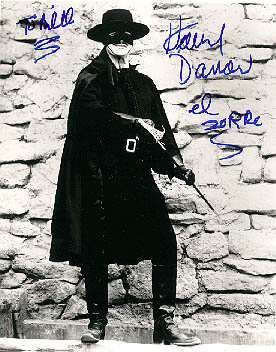
After the syndicated run of Zorro left the air in 1967, Disney lost interest in the caped adventurer. The Studio decided not to exercise its option to renew the contract for Zorro and the rights reverted to the Gertz estate that year.
Even though Disney had given up on Zorro, others had not lost interest and numerous Zorro movies were produced in the following years. Many of these were filmed overseas, such as the popular 1974 French production of Zorro with Alain Delon in the title role. The same year also saw The Mark of Zorro, a made-for-television movie starring Frank Langella, which marked Zorro's return to the American market. Several years later, in 1980, Zorro, The Gay Blade provided a decidedly different twist to the tale, with George Hamilton as a homosexual Don Diego. Zorro even made it to Saturday morning in The New Adventures of Zorro, an animated series that ran for 13 episodes in 1981.
The return of Zorro
This continued interest was not lost on Disney, for the Studio kept getting requests to bring its Zorro series back. Unfortunately, Zorro was one of the few television projects Walt had decided not to film in color, and company executives felt that modern audiences would not watch a black-and-white series.
The most obvious solution was to make new episodes, but by the 1982-83 season, there were no half-hour drama series on the air anymore. Sitcoms were the current rage, and with this in mind, CBS told Disney they would only be interested in new Zorro episodes if the series was switched to a comedy format.
Anxious to get a series on the air, Disney agreed to produce Zorro and Son, a sitcom, as another limited series. The premise was that twenty-five years had passed since the last Zorro episode, and the masked avenger has had to slow down as age takes its toll. When a new commandante begins a reign of terror, Don Diego realizes he can no longer fight as well as he used to. The solution is to have his son, Don Carlos, take his place, but the two men haven't spoken since an argument several years earlier. Luckily, Bernardo, as loyal as ever, manages to get them talking again. Don Carlos agrees to assume the role of Zorro, with Don Diego as his advisor, providing hints from the many lessons he learned when he had worn the mask.
Casting the series
When work first began on Zorro and Son, there was talk that Guy Williams would be returning again to play Don Diego. Some reports said that Williams had actually signed for the role, but that when he saw the scripts, he didn't like what the writers had done with "his" character and he quit before filming began.
Instead, Don Diego was played by Henry Darrow, a popular character actor with a long list of credits. Darrow had provided the voice of Zorro in the 1981 animated series, making him one of a few actors who had played the part in different productions. Paul Regina, a relative newcomer, was cast as Don Carlos, and it was to him that most of the action scenes would fall. Bernardo was played by Bill Dana, who is best known for his "Jose Jimenez" character. In this version, Bernardo no longer was a mute.
The move to a situation comedy meant that the role of Sergeant Garcia was no longer needed for comedy relief, so the part was dropped. In addition to Don Diego, Don Carlos and Bernardo, the continuing characters were:
Capitan Paco Pico, the new commandante, who headed the troops stationed in the Casa de Cops, home of the pueblo's military presence.
Sergeant Sepulveda, Pico's second in command. For those unfamiliar with Los Angeles, Pico and Sepulveda are major thoroughfares.
Brothers Napa and Sonoma, a pair of dour twin monks. The two monks were never seen together, making the part of twins noticeable only for the names, which were based on California's wine growing region.
Corporal Cassette, played by the fast-talking John Moschitta, who had gained fame in numerous commercials for his very rapid speech. Cassette's usual role was to infiltrate a crowd and then quickly repeat all of the conversations he overheard verbatim to the commandante.
A link with the past
Zorro and Son benefited from the fact that most of the original exterior sets from Zorro were still standing on the Burbank lot. Disney had also kept many of the original props and costumes in storage all these years, which helped make the limited series look like a far more expensive production than it actually was.
The new series also established a link to the original version in the opening titles. Black-and-white scenes from the old shows were mixed with color clips from the new episodes, along with a new rendition of the theme song that sounded almost identical to the original song. This time out, the theme was updated to reflect the use of two Zorros, with lines such as "They make the sign of the Z's".
Unfortunately, the updated Zorro and Son failed to catch on with viewers, attracting only 13% of the viewing audience each week. After the five episodes were aired, the series quickly vanished from sight. Once again, Disney gave up the rights to Zorro, and today, this series is mercifully all but forgotten.
There is one interesting footnote. In 1989, production began on yet another version of Zorro, this time by New World Cinema. Henry Darrow was signed to play Don Alejandro, making him the only actor to work in three different versions of the story.
Production Credits
Cast: Henry Darrow (Don Diego de la Vega/Zorro, Sr.), Paul Regina (Don Carlos de la Vega/Zorro, Jr.), Bill Dana (Bernardo), Gregory Sierra (Capitan Paco Pico), Richard Beauchamp (Sergeant Sepulveda), Barney Martin (Brothers Napa and Sonoma), John Moschitta, Jr. (Corporal Cassette).
Developed for Television by: Eric Cohen. Executive Producer: William Robert Yates. Produced by: Kevin Corcoran. Supervising Producer: Eric Cohen. Director of Photography: Ron Vargas. Production Designer: John B. Mansbridge. Editors: Gordon D. Brenner, A.C.E., Dennis A. Orcutt, Ernie Milano, A.C.E. Unit Production Manager: Paul Wurtzel. First Assistant Directors: Doug Metzger, Ramiro Jaloma. Second Assistant Director: James M. Freitag. Set Decorator: Norman Rockett. Special Effects: Roland Tantin. Sound Supervisor: Bob Hathaway. Sound Mixer: Arthur Names. Creative Consultant: Nancy Larson. Costume Supervisor: Jack Sandeen. Men's Costumer: Milton Mangum. Women's Costumer: Karen Hytten. Make-up Supervisor: Robert J. Schiffer, C.M.A.A. Make-up: Robin LaVigne. Hair Stylist: Edie Panda. Music by: George Duning. Casting: Bill Shepard, A.S.C.D. Zorro and Son is produced with the cooperation of Gertz-Larson Productions.
Each of the episodes is described below in airdate order.
Zorro and Son (pilot)
Airdate: 4/6/83. Guest Cast: Jack Kruschen (Commandante La Brea), Catherine Parks (Señorita Anita). Written by: Eric Cohen. Directed by: Peter Baldwin.
Twenty-five years after he first rode to avenge evil, Zorro has begun to slow down, for his age is catching up to him. Unwilling to abandon his crusade for justice, he has switched tactics and now tries to outwit his foes rather than outfight them. However, when Brother Napa is arrested for selling wine before its time, is unjustly jailed, Zorro again takes up his sword to duel with the pueblo's evil commandante. The years have also taken their toll on his foe, Commandante La Brea, who surprisingly decides to retire during their fight. His replacement is the younger Capitan Paco Pico, who takes over the duel. Zorro barely escapes and it appears that his dashing days are over for good.
Bernardo saves the day by summoning home Don Carlos, the estranged son of Don Diego, and father and son discover a common bond - a hate of injustice. Diego tells his son of his secret identity and begins to train him to take his place as the masked rider. All too soon, Carlos is put to the test when he must free the monk from a public flogging. The two Zorros unite to save the prisoner and begin a new chapter in frontier adventures.
Production Note: Jack Kruschen had appeared as a villain in The Man with the Whip and The Cross of the Andes episodes of the original Zorro series.
Beauty and the Mask
Airdate: 4/13/83. Guest Cast: Gina Gallego (Angelica), Vic Dunlop (Rapido Roberto), Pete Leal (Peasant/Prisoner), Ernie Fuentes (Peasant), Rita Rogers Aragon (Angelica's Mother). Written by: Eric Cohen, Nick Arnold. Directed by: Gabrielle Beaumont.
Commandante Pico's plan to capture Angelica, a suspected gun runner, fails and the rebel reaches the monastery of Brother Napa. Don Carlos, who has been entertaining the children there, rushes to her rescue when Pico follows her and tries to take her back to town. Dressed as Zorro, Carlos takes her to his house, where he promises she'll be safe.
Carlos later returns home out of costume and "agrees" to honor Zorro's pledge, but Pico arrives shortly after and searches the hacienda. The soldiers discover Angelica and the commandante threatens to torture her mother unless the rebel helps capture Zorro.
Matters become complicated when Carlos tells his father he is in love with Angelica and wants to reveal his secret. Later, when Diego learns that Angelica is spying for Pico, he searches for his son, who is about to unmask in front of her. Angelica stops Carlos and confesses that she is working for Pico, but the episode ends happily when Zorro frees her mother.
A Fistful of Pesos
Airdate: 4/20/83. Guest Cast: Pete Leal (Peasant), Don Diamond (Passenger #1), Danny Mora (Passenger #2), Thomas Rosales (Gomez). Written by: Eric Cohen, Nick Arnold. Directed by: Alan Myerson.
Commandante Pico tries a new tactic to end Zorro's influence over the pueblo when he disguises himself in the characteristic black mask and begins robbing the peons. Unaware of this plot, Don Diego is dismayed when the people begin turning against him. When Bernardo discovers the reason, Diego decides to clear his name and avenge this injustice.
Don Carlos has his own reason for revealing the real thief, for he himself was accused of the crimes to pay off a gambling debt. He dresses as Zorro and follows a stagecoach he suspects will be the fake Zorro's next target. Diego discovers his son's absence and also rides as Zorro, meeting Carlos just as the stage arrives. The two men are so busy arguing over who should be the one to catch the imposter that Pico has time to rob the stage, again dressed as Zorro.
Diego decides to outwit the thief by enlisting the help of Brother Sonoma, who supplies a valuable religious relic as bait for a trap. The plan works and Pico tries to steal the treasure, only to be confronted by the real Zorro. A band of soldiers interrupts the fight and seizes one of the masked men, who is unveiled as the commandante. Zorro escapes once more, and the people learn the truth about their hero.
Production Note: This plot is similar to that of the episodes Double Trouble For Zorro and Zorro, Luckiest Swordsman Alive from the original series.
Wash Day
Airdate: 4/27/83. Guest Cast: Catherine Parks (Señorita Anita), Pete Leal (Peasant). Written by: Eric Cohen, Nick Arnold. Directed by: Peter Baldwin.
An unusual problem develops for Zorro when Bernardo tries to wash his costume, for a gust of wind blows the clothes into the picnic lunch of Commandante Pico. The soldier arrests Bernardo and takes him to jail, hoping to prove that Don Diego is the masked rider. He sends for Diego and accuses him, but when Diego is forced to wear the costume, it has shrunk and no longer fits him. Pico tortures Bernardo to learn Zorro's identity and the faithful servant confesses that he is the masked rider in the hope of saving Diego.
The ruse seems to work and Diego is set free. He and Don Carlos begin planning to rescue Bernardo, but without their costumes, they are unable to ride as Zorro. They find an unexpected ally in Sergeant Sepulveda, who feels sorry for Bernardo and has restored the garments to their original size. Before Sepulveda can tell Bernardo where the clothes are, Pico takes the prisoner out to execute him. Diego and Carlos search for the costume and discover it moments before the execution. Carlos rescues Bernardo as Diego watches with Pico, thereby seemingly confirming that his father cannot be Zorro.
The Butcher of Barcelona
Airdate: 5/04/83. Guest Cast: Dick Gautier (El Excellente), Catherine Parks (Señorita Anita), H.B. Haggerty (Capitan Jorge Mendez), Ralph Manza (Waiter), Michael Salcido (Prisoner). Written by: Eric Cohen, Nick Arnold. Directed by: Gabrielle Beaumont.
Commandante Pico receives unwelcome news that a life-long rival, El Excellente, is due to arrive for an inspection of the pueblo. He is unaware that Zorro will also be unhappy about the visit, for El Excellente is guarded by Capitan Jorge Mendez, who hates the masked rider and has nearly captured him on several occasions. Diego fears that Mendez, a cruel and harsh man known as the "Butcher of Barcelona", will be named to run the pueblo.
Pico asks Diego for help in preventing El Excellente from removing him from office, and Diego forces a return of tax money to the peons in return for the favor. Don Carlos upsets the agreement by cutting a "Z" on El Excellente's shirt as punishment for mistreating Brother Napa, and the visitor angrily fires Pico. Just as Diego feared, Mendez is made the new commandante.
Diego talks El Excellente into reinstating Pico provided the commandante can capture Zorro in 24 hours. Carlos agrees to impersonate Zorro and lose a battle in front of El Excellente, but when the confrontation begins, Pico faces a masked man claiming to be the real Zorro. Mendez leaps into the battle and is quickly defeated, forced by Zorro into a well.
El Excellente decides to leave Pico in charge, and a surprised commandante thanks Zorro for his help. The masked man tells him he only helped because Mendez would have been even a worse ruler than Pico. Once again, Pico and Zorro resume their rivalry.